And the Oxford Word of the Year 2025 is…
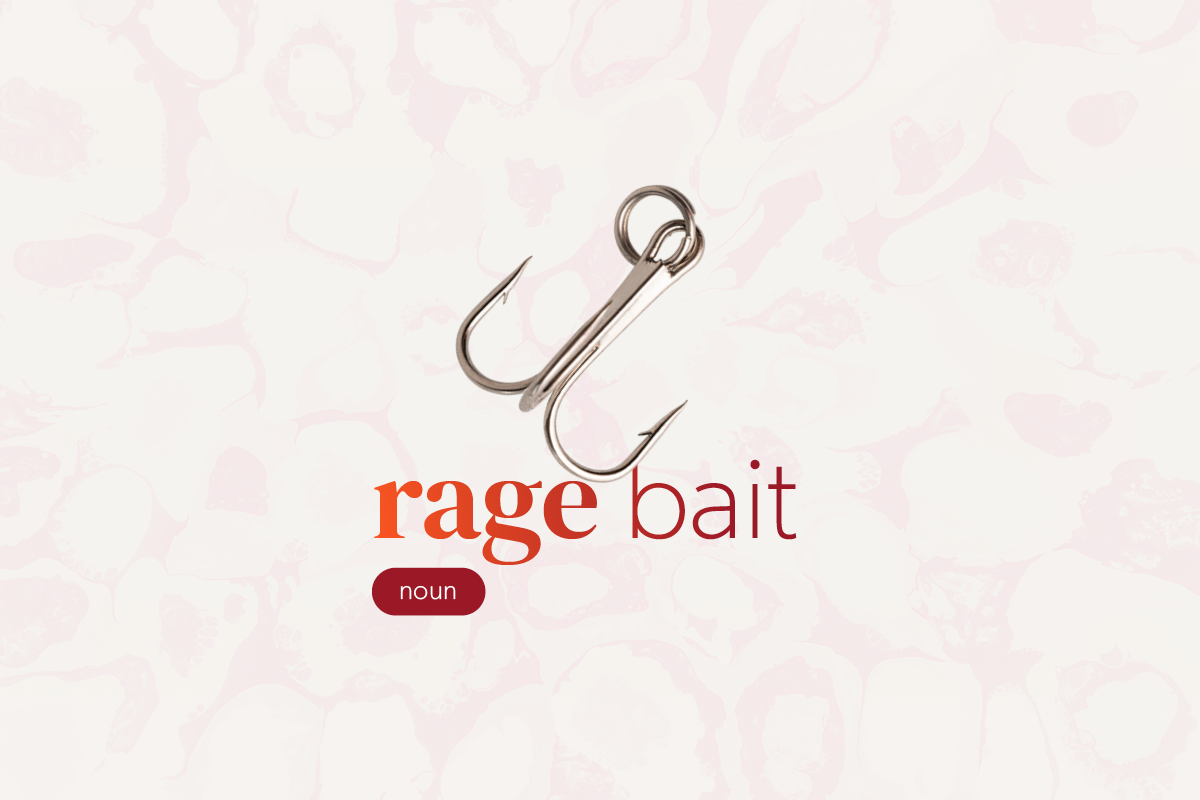
rage bait
(n.) Online content deliberately designed to elicit anger or outrage by being frustrating, provocative, or offensive, typically posted in order to increase traffic to or engagement with a particular web page or social media account.

The internet’s most effective hook
After three days of voting in which more than 30,000 people had their say, we have chosen rage bait as our official Oxford Word of the Year for 2025.
With 2025’s news cycle dominated by social unrest, debates about the regulation of online content, and concerns over digital wellbeing, our experts noticed that the use of rage bait this year has evolved to signal a deeper shift in how we talk about attention—both how it is given and how it is sought after—engagement, and ethics online.
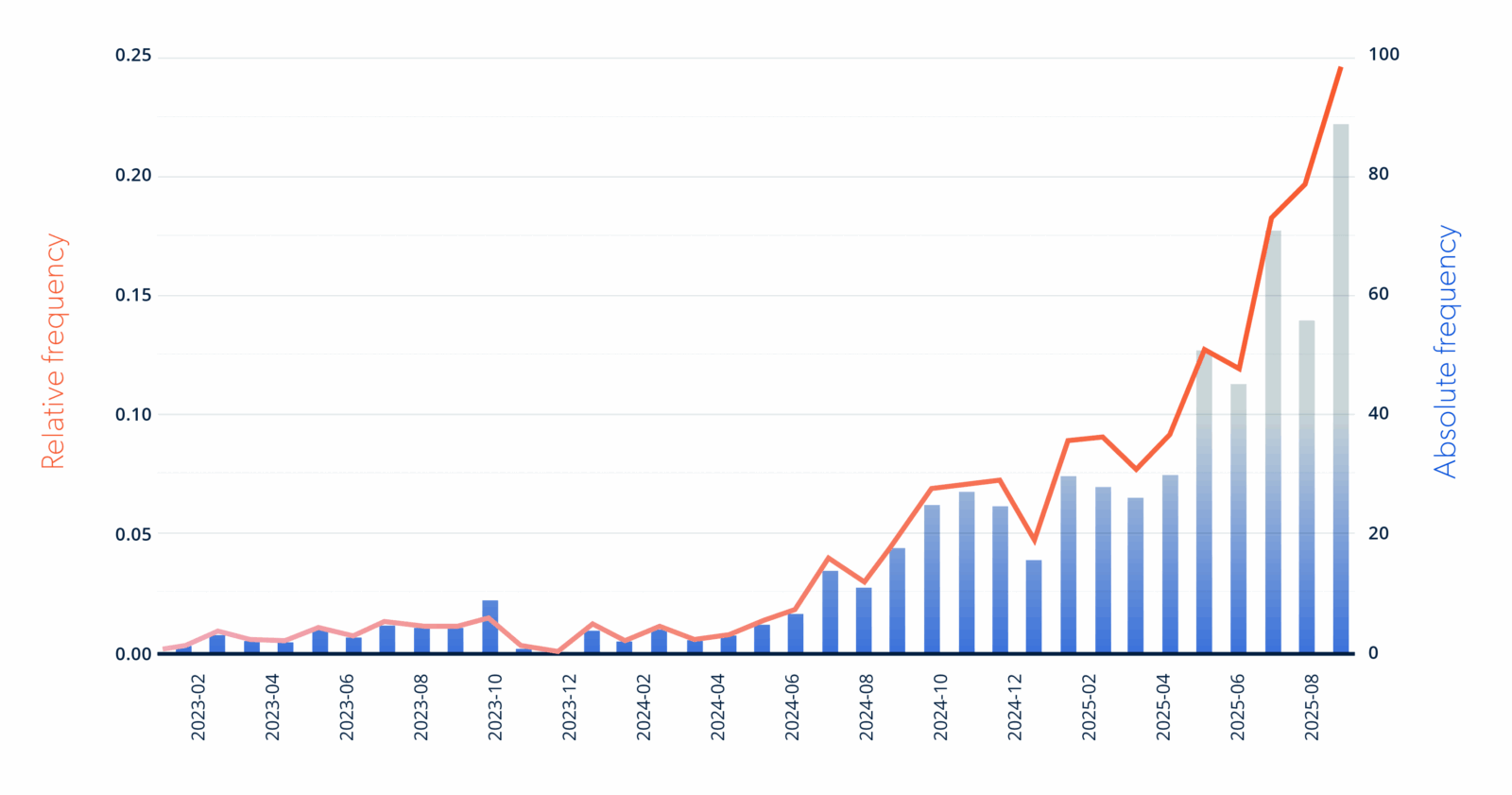
The word has also increased threefold in usage in the last 12 months, according to our language data.
Isn’t rage bait two words?
We’re not rage baiting you by choosing two words—though that would be in keeping with the meaning of the term!
The Oxford Word of the Year can be a singular word or expression, which our lexicographers think of as a single unit of meaning.
Rage bait is a compound of the words rage, meaning a violent outburst of anger, and bait, an attractive morsel of food. Both terms are well-established in English and date back to Middle English times. Although a close parallel to the etymologically related clickbait, rage bait has a more specific focus on evoking anger, discord, and polarization.
The emergence of rage bait as a standalone term highlights both the flexibility of the English language, where two established words can be combined to give a more specific meaning in a particular context (in this case, online) and come together to create a term that resonates with the world we live in today.

Casper Grathwohl
President of Oxford Languages
“The fact that the word rage bait exists and has seen such a dramatic surge in usage means we’re increasingly aware of the manipulation tactics we can be drawn into online. Before, the internet was focused on grabbing our attention by sparking curiosity in exchange for clicks, but now we’ve seen a dramatic shift to it hijacking and influencing our emotions, and how we respond. It feels like the natural progression in an ongoing conversation about what it means to be human in a tech-driven world—and the extremes of online culture.
“Where last year’s choice, brain rot, captured the mental drain of endless scrolling, rage bait shines a light on the content purposefully engineered to spark outrage and drive clicks. And together, they form a powerful cycle where outrage sparks engagement, algorithms amplify it, and constant exposure leaves us mentally exhausted. These words don’t just define trends; they reveal how digital platforms are reshaping our thinking and behaviour.”
Learn more about our 2025 shortlist
aura farming
(n.) The cultivation of an impressive, attractive, or charismatic persona or public image by behaving or presenting oneself in a way intended subtly to convey an air of confidence, coolness, or mystique.
Origin
A compound of the words aura and farming.
aura: a borrowing from Latin, based on a Greek original, meaning ‘breath, breeze’ and first recorded as meaning ‘a gentle breeze’ in Middle English. It is more familiar in the sense relating to a supposed psychic or spiritual emanation or field surrounding a living being or thing, and the general impression or character that a person has.
farming: recorded from the 15th century with the sense ‘the action or system of renting out land or property for money’, but more familiar in the sense referring to the cultivation of crops or raising of livestock.
Why is it in our shortlist?
aura farming has been growing in use since its first appearance online in 2023. It surged this year, reaching a peak in July, largely as a response to a viral video of 11-year-old Rayyan Arkan Dikha from Indonesia looking effortlessly cool as he carried out his role as a motivational dancer for the crew of a traditional racing boat.
Its increase in usage seems to show us that sometimes, a conscious effort goes into producing that ineffable attractive something that some people just seem to have.

biohack
(v.) To attempt to improve or optimize one’s physical or mental performance, health, longevity, or wellbeing by altering one’s diet, exercise routine, or lifestyle, or by using other means such as drugs, supplements, or technological devices.
Origin
A compound of the combining form bio- and the verb hack.
bio-: a borrowing from Latin ultimately from a Greek original. It has been present in English as a building block of new words relating to life and living organisms since the 19th century, but is also familiar from earlier borrowings from Latin, such as biology and biographer.
hack: first recorded with the sense ‘to cut or chop with heavy blows’ before the year 1200, and now also familiar in extended uses originating in computing, meaning ‘to modify (something) in order to provide a solution or workaround to a problem’ or ‘to apply an unorthodox strategy or expedient solution to adapt or optimize (something)’.
Why is it in our shortlist?
biohack has come to prominence over recent months with increased attention to the efforts of some of us—especially the rich and powerful—to turbocharge our mental or physical performance, or to halt or reverse the ageing process.
As a result, we’ve seen a doubling of usage in the past year, suggesting that, while some of the treatments and interventions used by hardcore biohackers are beyond the reach of most of us, we seem to be endlessly fascinated by efforts to cheat ill health, old age, or death itself.

rage bait
(n.) Online content deliberately designed to elicit anger or outrage by being frustrating, provocative, or offensive, typically posted in order to increase traffic to or engagement with a particular web page or social media account.
Origin
A compound of the words rage (violent outburst of anger) and bait (an attractive morsel of food).
Why is it in our shortlist?
rage bait has seen a threefold increase in usage over the last year, suggesting that more people than ever are aware of the negative effects that online life can bring alongside all the positives.
This significant increase suggests that people have the sense that they are being drawn ever more quickly into polarizing debates and arguments as a response to social media algorithms and the addictive nature of outrage content, and speaks to a trend in media generally that rewards rage bait with engagement.

Our approach
Every year, our lexicographers analyse the English language to summarize words and expression that have reflected our world during the last 12 months.
We analyse data and trends to identify new and emerging words and expressions, which our lexicographers think of as a ‘single unit’, and examine the shifts in how more established language is being used. The team also consider suggestions from our colleagues and the public, and look back at the world’s most influential moments of the year to inform their shortlist—culminating in a word or expression of cultural significance.
2025 was a year defined by the transformation of humanity in a tech-driven world. As technology and artificial intelligence become ever more embedded into our daily lives—from deepfake celebrities and AI-generated influencers, to virtual companions and dating platforms—our society has been asking questions around who we truly are, online and offline.
For the first time, we let our words show you who they really are, as they campaigned for your vote.
aura farming, biohack, and rage bait canvassed for the public’s votes on Instagram, offering us a peek into their unique stories about the year we’ve lived and the influence they’ve had.


Defining the world around us since 2004
Find out all about the history of Oxford Word of the Year.
We take a look at our past winners and shortlisted candidates, and explore some of the key themes, developments, and moods that they have captured over the years.


Recent winners
Read more about some of our winning words and how we chose them, with insights shared by our Oxford Languages team.
2024: brain rot
After more than 37,000 people had their say, our experts came together to consider the public’s input, voting results, and our language data, before declaring brain rot as the definitive Word of the Year for 2024. Our experts noticed that the term had gained new prominence in 2024, referring to low-quality, low-value content found on social media and the internet, as well as the subsequent negative impact that consuming this type of content is perceived to have on an individual or society.

2023: rizz
Through head-to-head contests held over an action-packed four-day period, over 30,000 people whittled a shortlist of eight words down to four finalists—rizz, Swiftie, situationship, and prompt. Our language experts considered our corpus data, the number of votes, and public commentary, before we announced rizz as the Oxford Word of the Year 2023.
2022: goblin mode
As the world began to open up after the pandemic, we opened up the Oxford Word of the Year to a public vote in 2022—the first time in our history—giving people worldwide a chance to choose from our shortlist. Over 340,000 votes later, goblin mode took the crown with a 93% share of the vote, beating metaverse and #IStandWith.
2021: vax
As Covid vaccinations began to roll out, we noticed the growth of the term ‘vax’ and its multiple derivatives, and the range of contexts it was being used in—such as getting vaxxed, fully vaxxed, and vax cards.
2020: Words of an Unprecedented Year
We decided that we could not sum up the events of 2020 and the pandemic with a single word, given the range and speed of change during the year. Instead, we released a report on the Words of an Unprecedented Year.
2019: climate emergency
Heightened public awareness of climate science and the implications for communities around the world generated enormous discussion around the world. In 2019, our research found an escalation in the language people use to articulate information and ideas concerning the climate—leading us to name climate emergency as Word of the Year and to compile a themed shortlist of words increasingly being used about the climate.
Related stories